
« The sector must deal with significant investments and relatively low volumes of machinery. That is why maintaining a long-term economic vision is essential.»
27/05/2026
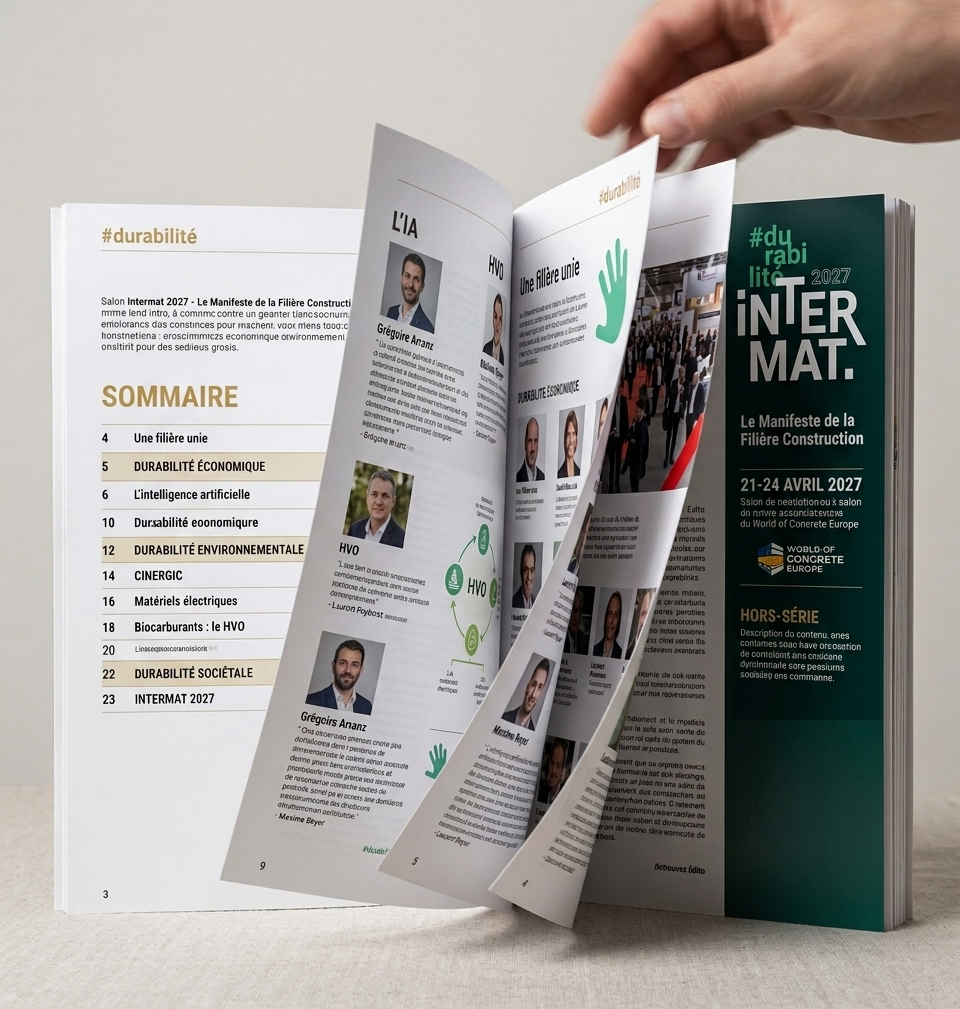
1 year before INTERMAT 2027, discover a brand-new special issue: The construction sector facing the challenge of sustainability
A sector in motion, at the heart of sustainability challenges
In a context marked by energy tensions, regulatory changes, and evolving professions, sustainability emerges as the guiding thread of this publication.
Far beyond its environmental dimension, it is explored through its three essential components:
• Economic: how can investment viability and business competitiveness be ensured in a transition context?
• Environmental: what concrete solutions exist to decarbonize construction sites and adapt energy models?
• Societal: how can companies attract, train, and retain talent while transforming working conditions?
These three complementary perspectives structure the entire special issue and reflect the pillars of INTERMAT 2027.
Key insights to anticipate transformations
Throughout the document, several major insights emerge:
• The transition is now underway, but scaling it up remains dependent on still-fragile economic, energy, and regulatory balances.
• Solutions exist whether electrification, biofuels, or artificial intelligence—but their deployment depends on real-world usage and market conditions.
• Cooperation between stakeholders is becoming crucial, as illustrated by collective initiatives across the sector to structure responses.
• Human capital is emerging as a strategic issue in a sector under pressure, which must renew its attractiveness and support skills development. This special issue highlights a sector that is both fully aware of its challenges and
What the experts say
« The construction equipment sector operates with relatively low production volumes—ranging from a few hundred to a few thousand machines—which limits industrial scaling effects. However, the ongoing transformation requires us to scale up (…).»
« For the sector, sustainability also depends on the ability to evolve professions, attract new profiles, and support skills development. INTERMAT makes these transformations very tangible: it showcases both technologies and their impact on practices, organizations, and training needs. This broader perspective is essential to sustainably support the sector»
A table of contents structured around the sector’s major challenges
The special issue offers a clear and progressive reading of the challenges through a rich and practical structure:
1
Conditions for a viable transition
2
Artificial intelligence as a competitive driver
3
The economic balance between equipment ownership and rental
4
INTERMAT’s role in the sector’s economic debate
1
The rise of multi-energy solutions
2
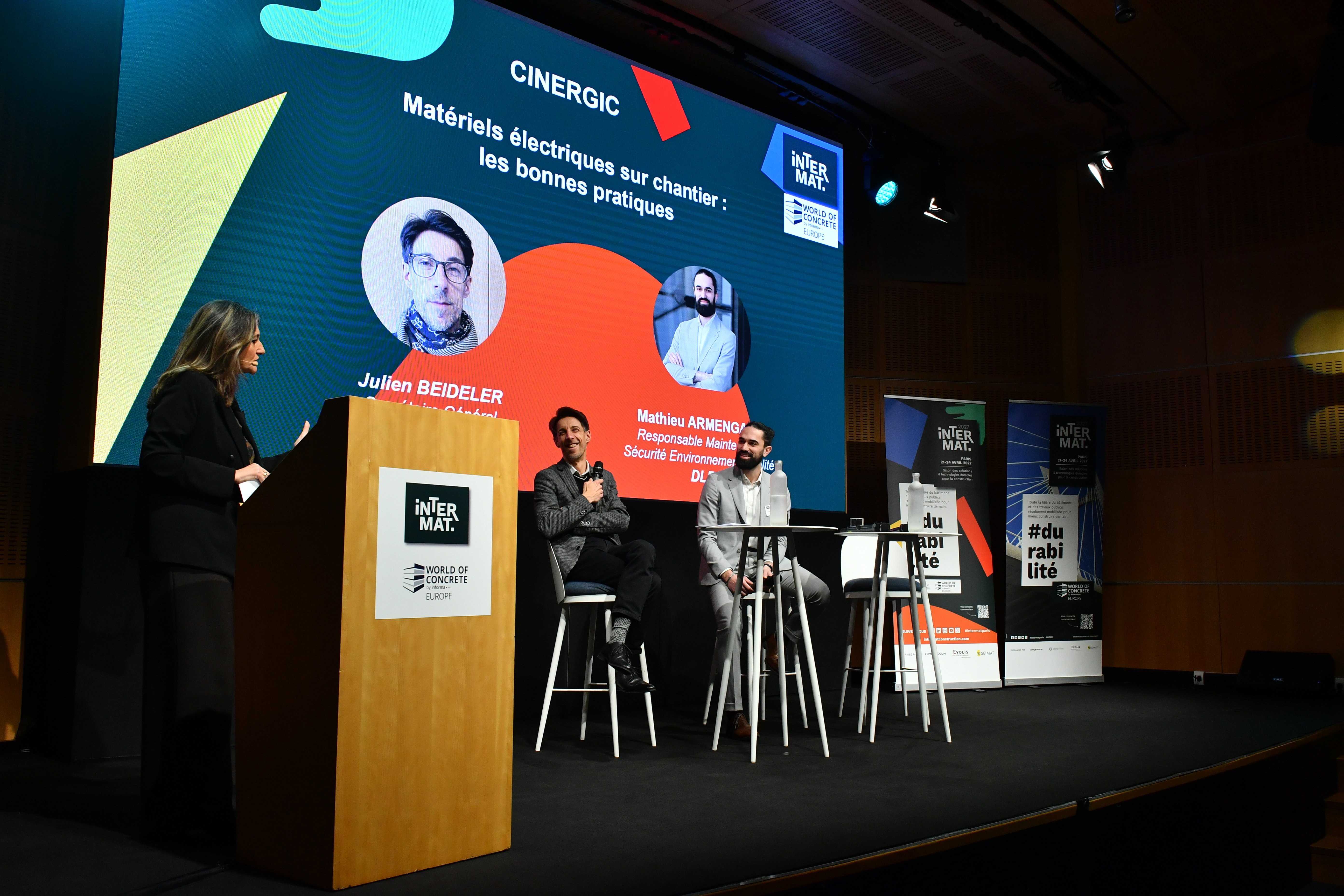
The structuring role of CINERGIC
3
The challenge of scaling up electric equipment
4
The potential of biofuels, particularly HVO
5
Solutions tested in real conditions at INTERMAT 2027
1
Attractiveness and recruitment challenges
2
The transformation of professions through technology
3
Skills development and career pathway support
Key Indicators
The construction sector in Europe represents :
10,6 %
of European GDP
12 M
million jobs
3,8 M
million companies, the majority of which are SME
Source : FIEC
A preview of INTERMAT 2027
More than just an overview, this document is a genuine invitation to continue discussions at INTERMAT 2027.
From April 21 to 24, 2027, at Paris Nord Villepinte, the exhibition will bring together all construction stakeholders to test solutions in real conditions, share feedback, and collectively accelerate the sector’s transformation
From April 21 to 24, 2027, at Paris Nord Villepinte, the exhibition will bring together all construction stakeholders to test solutions in real conditions, share feedback, and collectively accelerate the sector’s transformation